JOAN SELVERSTONE VALENTINE, Professor 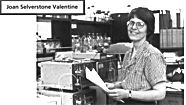
(b. 1945) A.B. 1967, Smith College; Ph.D. 1971, Princeton University; NIH Postdoctoral
Fellow 1972; Rutgers University 1972-80; Fellow of the AAAS, 1979; Alpha Chi Sigma Faculty
Research Award 1985; Smith Medal 1991; Associate Editor, Inorganic Chemistry, 1989-present.
The research in our laboratory is divided into three major projects. They are (1)
investigations of the modes of activation of dioxygen and species derived from dioxygen,
i.e. superoxide, peroxide, etc., by transition metal-containing species, (2) studies of
the enzyme copper-zinc superoxide dismutase, and (3) immobilization of enzymes and other
proteins in transparent glasses using novel sol-gel techniques.
Activation of Oxygen by Transition Metal Complexes
The object of the first project is an increased understanding of the nature of reactive
intermediates produced in reactions of metalloenzymes and other metal-containing
catalysts that bind
dioxygen, catalyze dioxygen reduction, or catalyze reactions of dioxygen with organic
substrates. Reactions of metal ions and complexes with dioxygen, superoxide, peroxides,
and single oxygen donors are being studied. We have been particularly successful in
finding that metal ion salts and non-porphyrin metal ion complexes catalyze epoxidation
of olefins by such oxidants. Until recently, most of the research in this area was
concentrated on catalytic reactions of metalloporphyrins. We are now engaged in
elucidation of the mechanisms of these reactions.
Metalloprotein Ligand Redesign
The object of the second project is the elucidation of the chemical, physical, and
biological properties of the enzyme copper-zinc superoxide dismutase (Cu,Zn-SOD).
This enzyme is found in the cytosol of almost all eukaryotic cells and in some
bacteria and is proposed to function in the cell as a protective agent against toxic
effects of superoxide. In our current research, we are concentrating on two areas:
(1) the redesign of CuZnSOD using site-directed mutagenesis to make and characterize
new synthetic metalloproteins and (2) exploration of the biological role of CuZnSOD
in protection against dioxygen toxicity and in copper metabolism by studying mutant
strains of yeast either containing no CuZnSOD or containing abnormally high levels of
CuZnSOD.
Immobilization of Proteins in Transparent Glasses Using Sol-Gel Techniques
The third project is a collaboration between myself and Professor Jeffrey I. Zink of my
department and Professor Bruce Dunn of the Department of Materials Science and
Engineering. The object of the project is the demonstration that proteins encapsulated
in sol-gel glass matrices may be used as optically based sensors. The unique aspect
of the sol-gel system is the ability to make optically transparent glasses that retain
the proteins in their pores but that are porous enough to transport small molecules at
reasonable rates. Because these glasses are transparent, optical changes of the
immobilized protein, the substrate, or the products of an enzymatic reaction may
be readily monitored. Initial work in our laboratories has lead to the development
of a novel synthetic technique which has enabled us to immobilize several enzymes
and other proteins in stable, optically transparent, inorganic glass matrices using
mild conditions such that these biomolecules retain a high degree of their enzymatic
activity and their native spectroscopic properties within these matrices. Moreover,
preliminary evidence indicates that the thermal stability of the encapsulated proteins
is significantly enhanced. Our goals for the future are to investigate the physical and
biological properties of this new class of biomaterials and to develop sol-gel
encapsulated enzymes and other proteins for use as biosensors.
Representative Publications
Iron-Cyclam Complexes as Catalysts for the Epoxidation of Olefins by 30% Aqueous Hydrogen
Peroxide in Acetonitrile and Methanol. Nam.W.; Ho, R.: Valentine, J.S.:
J. Am. Chem. Soc., 1991, 113, 7052-7054.
Lewis Acidic Catalysts for Olefin Epoxidation By Iodosylbenzene, Yang, Y.:
Diederich, F.: Valentine, J.S. J. Am. Chem. Soc., 1991, 113, 7195-7205.
ACE1, a Copper-Dependent Transcription Factor, Activates Expression of the
Yeast Copper Zinc Superoxide Dismutase Gene. Gralla, E.B.; Thiele, D.J.; Silar,
P.; Valentine, J.S. Proc. Natl. Acad. Sci., 1991, 88, 8558-8562.
Null Mutants of Saccharomyces cerevisiae Cu, Zn Superoxide Dismutase:
Characterization and Spontaneous Mutation Rates. Gralla, E.B.; Valentine,
J.S. J. Bacteriol., 1991, 173, 5918-5920.
Is Intramolecular Hydrogen-Bonding Important for Bleomycin Reactivity?
A Molecular Mechanics Study. Wu, Y.; Houk, K.N.; Valentine, J.S.; Nam, W.
Inorganic Chemistry, 1992, 31, 718-720.
Spectroelectrochemistry of Copper-Zinc Superoxide Dismutase. St. Clair, C.S.;
Gray, H.B.; Valentine, J.S. Inorganic Chemistry, 1992, 31, 925-927.
Enzymatically Active Biomolecules Encapsulated in Transparent Glass by
the Sol-Gel Method: Immobilization of Glucose Oxidase and Peroxidase. Yamanaka,
S.A.; Nishida, F.; Nishida, C.; Ellerby, L.M.; Dunn, B.; Valentine, J.S.; Zink, J.I.
Chemistry of Materials, 1992, 31, 925-927.
Encapsulation and Reactivity Studies of Proteins in Optically Transparent Porous
Glasses Prepared by the Sol-Gel Method. Ellerby, L.M.; Nishida, C.R.; Nishida, F.;
Yamanaka, S.A.; Dunn, B.; Valentine, J.S.; Zink, J.I. Science, 1992, 255, 1113-1115.
The Redesign of a Type 2 into a Type 1 Copper Protein. Construction and
Characterization of Yeast Cu,Zn Superoxide Dismutase Mutants. Lu, Y.; Gralla, E.B.;
Roe, J.A.; Valentine, J.S. J. Am. Chem. Soc., 1992, 114, 3560-3562.