CRAIG A. MERLIC, Associate Professor 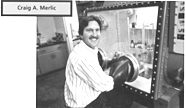
(b. 1959) B.S. 1982, University of California, Davis; Ph.D. 1988, University of
Wisconsin, Madison; NIH Postdoctoral Fellow 1988-1989, Princeton University;
National
Science Foundation Young Investigator Award, 1992-1997.
Our research program in organic and organometallic chemistry encompasses synthetic
organic, synthetic organometallic, and physical organometallic chemistry. Research goals
include discovery of new reactions and catalysts, development of synthetic methods,
determination of reaction mechanisms, analysis of reaction selectivity, synthesis of
bioactive
natural products and development of organometallic complexes for materials research. The
development of new chemistry using organometallic species is a rich and fertile area due to
the unique ability of transition metal fragments to impart special reactivity, selectivity, and
stability upon bonded organic moieties. Our research draws on these features to address
problems in organic synthesis.
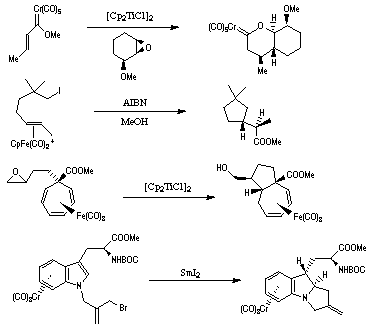
Organometallic Radical Reactions for Stereoselective Synthesis
Organometallic radical reactions are being investigated as new methods for carbon-
carbon bond formation. By using transition metal fragments to template the reactions of
organic moieties, complete control of chemoselectivity, regiochemistry and stereochemistry
in radical cyclizations will be feasible. A wide array of organometallic compounds are
employed including iron olefin complexes, cobalt alkyne complexes, iron triene
complexes,
chromium carbenes and arene chromium complexes. Applications of the newly developed
methodologies to the syntheses of biologically active products such as antitumor agents,
unnatural sugars, and antibiotics are under investigation.
Synthesis Via Metal-Mediated Pericyclic Reactions
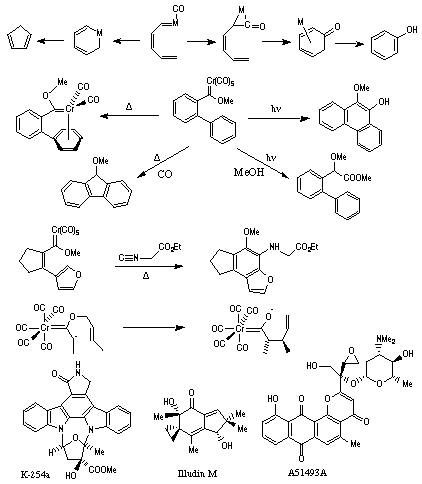
We are exploring fundamentally new types of pericyclic reactions by incorporating
metal fragments into reacting polyene arrays. The metals can participate directly in
pericyclic
reactions or can serve as templates to control reaction selectivity. Examples include
chromium carbene annulations that provide ortho substituted phenols under photolytic
conditions or cyclopentadienes via thermolysis and a chromium analogue of the Claisen
rearrangement. Second generation reactions will employ metal fragments catalytically.
Topics we seek to address in organometallic pericyclic reactions include reaction
mechanisms, selectivity rules, substrate variability and synthetic applications. These new
methodologies are applied to the synthesis of a number of structurally diverse antibiotic and
antitumor agents including Illudin M and A51493A and a protein kinase inhibitor K-254a.
Organometallic Stereoelectronics
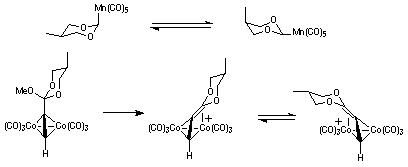
The conformation, stereochemistry and reactivity of many organic molecules are
controlled by stereoelectronic effects. Our aim is to develop the theory of organometallic
stereoelectronics and to elucidate stereoelectronic effects controlling the structure, reactivity
and stereoselectivity in the reactions of organometallic compounds. In contrast with
organic
compounds, the ability to alter ligands to fine tune the electronics of organometallic
complexes provides a unique feature which aids in the study of stereoelectronic effects.
Classes of compounds under study include boron metallocycles, metal substituted sugar
and
dioxane derivatives, chromium carbene complexes and iron and platinum alkene
complexes.
The insights gained will be applied to stereocontrolled organic and organometallic
synthesis.
Molecular Dynamics and Molecular Switches
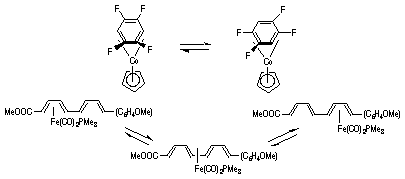
A variety of transition metal moieties exhibit remarkable selectivity in their mobility
when attached to polyene and polyenyl organic compounds. New methods of controlling
this fluxional coordination of polyene arrays to transition metals are under study in order to
elucidate the nature of bonding changes and explore the potential for electronic devices.
The
molecular dynamics of these fluxional processes present interesting challenges to structural
analysis and characterization. Discoveries in this area will be utilized for the development
of
novel types of molecular switching devices such as three state switches.
Representative Publications
- Trost, B.M.; Merlic, C.A. "Geminal Alkylation - Substitutions of Allyl Sulfones.
Regiocontrol via Molybdenum Catalysis," J. Org. Chem. 1990, 55, 1127-1129.
- Trost, B.M.; Merlic, C.A. "Ligand Dependence of Molybdenum Catalyzed
Alkylations. Molybdenum Isonitrile Complexes as a New Class of Highly Reactive
Alkylation Catalysts," J. Am. Chem. Soc. 1990, 112, 9590-9600.
- Merlic, C.A.; Semmelhack, M.F. "An Interesting Chloride Ion Effect in the Heck
Reaction," J. Organomet. Chem. 1990, 391, C23-C27.
- Merlic, C.A.; Xu, D. "Cyclization Reactions of Chromium Dienylcarbene
Complexes.
Entry to Ortho Substituted Aromatic Alcohols via a Designed Photoreaction" J. Am.
Chem. Soc. 1991, 113, 7418-7420.
- Merlic, C.A.; Xu, D. "Intermolecular Radical Reactions of Unsaturated Chromium
and
Tungsten Carbene Complexes," J. Am. Chem. Soc. 1991, 113, 9855-9856.
- Merlic, C.A.; Xu, D.; Khan, S. I. "Synthesis, Structure and Reactivity of Cyclic
Arene Chromium Carbene Complexes" Organometallics 1992, 11, 412-418.
- Merlic, C.A.; Adams, B. "Molybdenum-95 Nuclear Magnetic Resonance Studies
on
Molybdenum Carbonyl Complexes of Isonitriles and Amines" J. Organomet. Chem.
1992,431, 313-325.
- Merlic, C.A.; Burns, E. E.; Xu, D.; Chen, S. Y. "Aminobenzannulation Via
Metathesis of Isonitriles Using Chromium Carbene Complexes" J. Am. Chem. Soc.
1992, 114, 8722.
- Merlic, C.A.; Xu, D; Gladstone, B. G. "Aminobenzannulation Via
Photocyclization
Reactions of Chromium Dienyl(amino)carbene Complexes. Synthesis of Ortho Amino
Aromatic Alcohols" J. Org. Chem. 1993, 58, 538-545.
- Merlic, C.A.; Bendorf, H. A. "Titanium-Templated [4+2] Oxidative
Cycloadditions:
A Facile Route to 7-Hydroxynorbornenes" Organometallics 1993, 12, 559-564.
- Merlic, C. A.; Xu, D.; Nguyen, M. C.; Truong, V. " Stereochemistry of
Intermolecular Radical Reactions of Unsaturated Tungsten Carbene Complexes,"
Tetrahedron Lett. 1993, 34, 227-230.
- Merlic, C. A.; Burns, E. E. "Chemoselectivity in the Isonitrile Metathesis Route to
Aromatic Amines" Tetrahedron Lett. 1993, 34, 5401.
- Merlic, C. A.; Roberts, W. M. "Regioselectivity of Photochemical Annulations of
Chromium Carbene Complexes" Tetrahedron Lett. 1993, 34, 7379.
mjw