Honoring
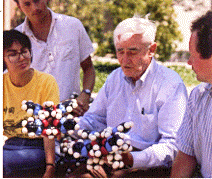
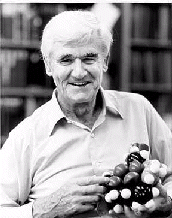
M. Frederick Hawthorne
November 8, 1997
Program
(Click on the thumbnail pictures below to see the full-size picture.)
Welcome...................................Chairman Emil Reisler
Introductions............................Prof. Christopher S. Foote
Reflections................................Prof. Donald J. Cram
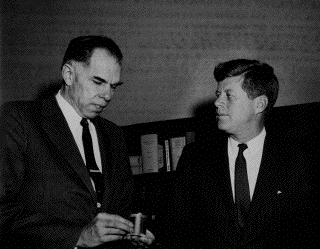
Award Presentation..................Prof. Glenn T. Seaborg


Remarks......................................Prof. M. Frederick Hawthorne


Acknowledgements.....................Dr. Brian Pierce
Close............................................Chairman Emil Reisler
The Glenn T. Seaborg Medal was established in 1987 by the UCLA Department of Chemistry and Biochemistry to honor and recognize an individual who has made significant contributions to chemistry or biochemistry. The medal is awarded annually.
M. Frederick Hawthorne
M. Frederick Hawthorne was born in 1928 in Fort Scott, Kansas. He entered the Missouri School of Mines and Metallurgy in Rolla, Missouri at the age of 14 as a part-time student in Chemical Engineering while simultaneously matriculating in high school. In 1947, he transferred to Pomona College and completed his B.A. degree in 1949. That same year, he began graduate work at UCLA, where he joined the research group of Professor Donald J. Cram (Seaborg Medalist in 1989). He became an Atomic Energy Commission Predoctoral Fellow in 1951. In 1953, Dr. Hawthorne began postdoctoral work in physical-organic chemistry with Professor George S. Hammond (Seaborg Medalist in 1994), then at Iowa State College.
In 1954, he took a position with the Redstone Arsenal Research Division of the Rohm and Haas Company, Huntsville, Alabama, where he took up the search for high--performance solid rocket propellants. He later founded an exploratory research group at Rohm and Haas (1956) which was concerned with the use of boron hydride derivatives as energetic rocket fuels. This enterprise led to the discovery of a new world of chemistry in which boron largely replaced carbon, and the ÒaromaticÓ polyhedral ions and carboranes for the first time became available for the development of novel molecules and their application throughout chemistry. Among these contributions was his discovery, in 1965, of borane and carborane cages which contain vertices comprised of metals from throughout the periodic table. This work, which wedded borane chemistry to metal coordination chemistry, originated following his appointment as Professor of Chemistry at UC, Riverside, in 1962.
In 1969, Dr. Hawthorne returned to UCLA as Professor of Inorganic Chemistry, where a large part of his research program is concerned with a binary radiological therapy for cancer known as boron neutron capture therapy. Also, in 1969 he became Editor-in-Chief of Inorganic Chemistry.
Dr. Hawthorne is a member of the U. S. National Academy of Sciences (1974), the American Academy of Arts and Sciences (1975), and a Corresponding Member of the Göttingen Academy of Sciences. He is the recipient of many honors and awards, the most recent being the 1997 Chemical Sciences Award of the National Academy of Sciences. He has served on many committees and advisory boards under the auspices of the Department of Defense, the Department of Energy, and the National Institute of Health.
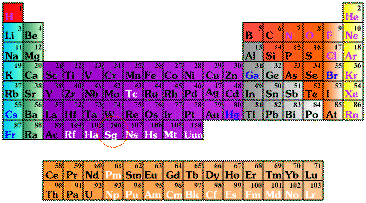
On the occasion of the Eleventh
Annual Glenn T. Seaborg Medal Dinner, the UCLA Department of Chemistry
and Biochemistry salutes Dr. Seaborg and celebrates the official naming
of element 106 as seaborgium. 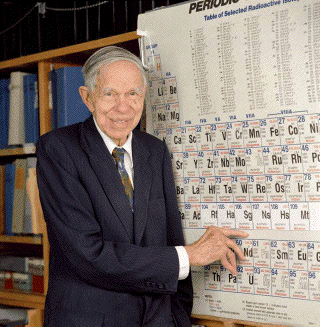
Glenn T. Seaborg was born in 1912 in the small mining town of Ishpeming, Michigan. The family moved to Los Angeles when Glenn was ten years old so that opportunities for the children would be greater. The young Glenn Seaborg drove to UCLA, where he received a B.A. in Chemistry in 1934. He then became part of a group of young scientists at UC, Berkeley, at the exciting time of Ernest O. Lawrence, who invented the cyclotron in 1929. He began his career in radiochemistry by performing the chemical experiments to identify transmutation products. He received a Ph.D. in Nuclear Chemistry from U.C., Berkeley, in 1937 and joined the University of California, Berkeley, faculty in 1939.
During World War II, he headed a group at the University of Chicago that devised the chemical extraction processes used in the production of plutonium for nuclear weapons. In 1940, Glenn Seaborg, Edwin M. McMillan, Joseph W. Kennedy, and Arthur C. Wahl bombarded a sample of uranium with deuterons and transmuted it into plutonium. This achievement was followed by the discoveries of a succession of transuranium elements, including americium, curium, berkelium, californium, einsteinium, fermium, mendelevium, nobelium, and finally seaborgium. For his discoveries in the chemistry of the transuranium elements, he was awarded the Nobel Prize in Chemistry with E. M. McMillan in 1951. He received the Atomic Energy CommissionÕs Enrico Fermi award in 1959 and the National Medal of Science in 1991.
In 1942, Dr. Seaborg achieved one of his greatest successes - marrying Helen Griggs, whom he met when she was secretary to Ernest O. Lawrence, founder of the Lawrence Berkeley National Laboratory. Together, he and Helen brought up six children - Peter, Lynne, David, Stephen, Eric, and Dianne - and are the proud grandparents of Lela (age 16) and Molly (age 13).
After his return to Berkeley, he served at the Radiation Laboratory (renamed the Lawrence Berkeley Laboratory) as Director of the Nuclear Chemistry Division, 1946-58 and 1972-75; Associate Director of the lab, 1954-61 and 1972-present; and Chancellor, UC, Berkeley, 1958-61. He was Chair of the Atomic Energy Commission from 1961-71. Since that time, he was appointed University Professor of Chemistry (the most distinguished title bestowed by the Regents). He was Director from 1982-84 and has been Chairman since 1984 of the Lawrence Hall of Science. He serves on many boards which further science education and has received numerous honorary degrees and awards.
Previous Seaborg Medalists
If you would like to be on the Seaborg Dinner mailing list, or if you wish to place someone else's name on our list, please fill out the form below and mail it to us. If you received a letter from us this year, you are already on our list.
Please include me on Seaborg Dinner mailings.
Name
Street Address (Home)
City/State/Zip
Grad?/Year/Degree
Employer
Title
Street Address (Work)
City/State/Zip
Phone (Work/Home)