last updated
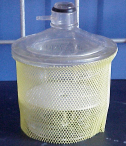
A desiccator is commonly used to dry solids. It consists of a thick-walled glass container and a lid. It can be evacuated and heated. The bowl should be covered with tape and plastic netting to provide protection in case the desiccator implodes.
A drying reagent (i.e., concentrated H2SO4, P4O10, anhydrous CaCl2, Drierite, etc.) is added in a bowl on the bottom of the desiccator to absorb a 'volatile solvent'. The drying can be carried out at ambient pressure or in vacuo. In either way, the ground glass joints have to be lubricated properly with special grease (very expensive!!). If the desiccator is under vacuum, it has to be stored in a secure spot afterwards. A label has to be attached on the top which informs other potential users about the content i.e., Compound A over concentrated sulfuric acid (James Miller, 1-14-2013).