last updated
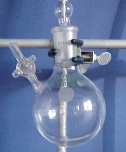
For many reactions in this course, the reaction vessel will be a Schlenk flask. It consists of a pear-shaped or a round-bottomed flask, which has a sidearm near the top to connect it to the vacuum/inert gas line. If you conduct experiments under inert gas, the glassware has to be appropriately prepared by flame-drying the equipment under vacuum. Here are some additional pointers to consider when you use Schlenk flasks:
1. The stopcock plugs has to fit tight into stopcock. There are several different types of stopcock plugs. The holes of the inner and outer part have to match in order to have a free passage. The stopcock plug is secured with a spring and/or retainer clip or a nut (if the stopcock plug has a thread). The plug is lightly lubricate to get a better seal (only for glass plugs, not for Teflon plugs).
2. All joints should be cleaned. There should not be any solids inside the joints because the female joint will break easily then.
3. The flask is clamped at the joint. The clamp has to have its 'rubber tips' to ensure that the glass does not get in direct contact with the metal, which usually leads to breakage as well. If there are no rubber tips, the experimenter can manufacture some by using small pieces of Tygon tubing (water hoses). The clamp has to have the appropriate size (not too small and not too big!) because it will have to support the entire weight of the setup.
4. The stirring bar has to be in good condition (Teflon coating intact).
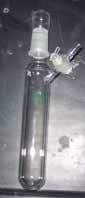
5. The picture below shows a Schlenk tube that can be used to carry out reactions or store air-sensitive materials. It possesses a male joint at the top.