last updated
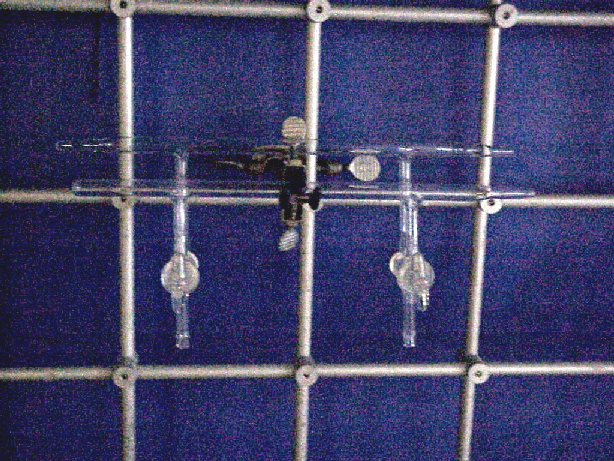
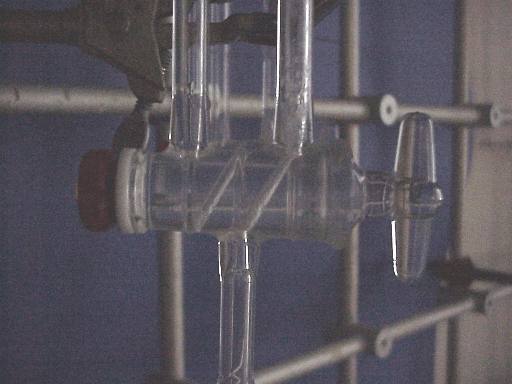
The top picture shows a typical setup for a vacuum line. It consists of a glass manifold, which is connected to a vacuum pump and an inert gas supply i.e., nitrogen or argon. The pictures below show the two "open positions" for the stopcocks in the glass manifold.
1. The vacuum part of the Schlenk line is connected to a low-temperature trap to protect the pump from harmful vapors. It has to be submerged in a Dewar container with liquid nitrogen (or an isopropanol/ dry ice bath), when the pump is running. The line has to be closed before the Dewar container is filled with liquid nitrogen to prevent the condensation of air. Condensed air can cause heavy explosions for many reasons. Once the cooling source is removed, the liquefied air will evaporate very fast and causes an overpressure in the system. Also, nitrogen has a lower boiling point than oxygen. Liquid oxygen will stay behind and react violently with any organic materials collected in the trap. After the pump was turned off, the Schlenk line has to be vented immediately. The Dewar with liquid nitrogen has to be removed at this point as well. Careful: Liquid nitrogen has a temperature of T=-196oC and causes severe forst bites.
2. The pumps in the laboratory are mechanical pumps. They employ a rotor that revolves inside a cylindrical stator. A thin film of oil maintains a seal between fixed and moving parts. Therefore, it is imperative that the oil is not contaminated by any other materials (i.e., organic solvents, corrosives, etc). The vacuum that can be reached with these pumps is in the range of 10-2 torr.
3. The inert gas part of the Schlenk line is connected to a tank of nitrogen or argon. At the end of the line, a pressure release bubbler (ideally with a ball joint on the inside) is attached to monitor the pressure in the inert gas line. Whenever manipulations are performed on this part of the line, one has to make sure that there is a positive pressure in the line. If glassware with larger volumes is refilled, the refilling will have to be performed stepwise. If the stopcock is just opened, the pressure in the inert gas line will drop to ~10-1-1 torr. Small leaks will generate major problems then. If very sensitive materials are handled, one needs to make sure that the line is airfree.
4. A stopcock has two pathways to connect both parts of the manifold. Depending on the orientation, it connects the vacuum line or the inert gas line to the attached setup. It might be a good idea to 'color code' them to avoid confusion here.
5. Since several people are using the same inert gas line, the work has to be coordinated (i.e., refilling flame-dried glassware, filtrations, transfers of solids or liquids, etc.) among students in order to prevent major accidents from happening. Nobody will not be happy to find her/his solution in the inert gas line, because somebody refilled a large volume at one time and his refluxing setup bumped into inert gas line. Contamination of the line with other (corrosive/reactive) gases like ammonia, chlorine, etc should be avoided as well.