updated
A vacuum distillation is used when the boiling point of the compound (or the solvent) is too high (Tb>150 oC) in order to distill the compound (or the solvent off) without significant decomposition. The setup is similar to a micro-scale or semi-macroscale distillation. However, there are some important differences as well:
1. When a vacuum distillation is performed, a spin vane or spin bar has to be used instead of boiling stones
or boiling sticks, which do not work in vacuo. Alternatively, a small boiling capillary can be used (which has to be drawn from a Pasteur pipette).
2. The setup is
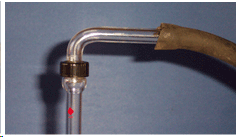
connected to the vacuum source (house-vac, aspirator) via thick-walled
tubing (=black tubing), which can withstand the pressure difference. Either a vacuum
adapter is used (semi-macroscale), or a drying tube on the top of the
air condenser for a microscale setup (shown below). All joints have to fit well to
allow for a good vacuum. A little vacuum grease on the ground-glass joints often improves the quality of the vacuum significantly because many pieces of glassware
in the lab do not fit 100 %.
3. The glassware has to be crack-free to prevent implosions to occur.
4.
The setup has to be secured using a metal clamp,
prefentially at the top of the Hickman head or the aircondenser.
5. When performing a vacuum distillation, the following sequence should heating and evacuation should be used:
a. All volatile solvents are evaporated off at ambient pressure (i.e., using the rotary evaporator).
b. The remaining liquid is allowed to cool down to room temperature and then transferred into
a smaller flask (or a conical vial) to reduce the loss. A spin bar (or spin vane) is added. The rest of the distillation setup is assembled making sure that there are no leaks.
c. The stirrer is
turned on and the entire setup is slowly evacuated without heating and
cooling. This way, the low boiling components in the mixture evaporate
away first, often being sucked into the vacuum line.
d. Then, the temperature is slowly raised while maintaining stirring and the vacuum. The water flow in the water-jacketed condenser is initiated (or the Hickman head is cooled using wet paper towels) in order for the boiling liquid to condense in the receiving flask (or Hickman head).
e. If the Hickman head fills up prior to finishing the distillation, the setup is raised from the hotplate to allow for some cooling. The tubing is disconnected from the vacuum source and then the liquid in the removed. Afterwards, the vacuum setup is re-assembled and the distillation continued until almost the entire compound is distilled.
5. Things to think about:
a. What is the boiling point of diethyl ether at p=30 mmHg? Which consequences does this have for the vacuum distillation?
b. Why is an excessive amount of not beneficial?
c. What will happen if the student heats up his mixture first and then applies the vacuum?
d. Which advantage does the vacuum distillation have over a normal distillation for propyl benzoate?