|
Research
Interests:
My
interests are in the area of science and technology at the ultimate limits
of fabrication, measurement and function. This fascination started when
I joined IBM in 1983 when I was fortunate enough to learn a new way to
see atoms and molecules. This ability to see or touch atoms and molecules
is one of the inspirational forces behind potentially revolutionary technologies
we will see in our lifetimes and we are just starting to make what were
dreams realities of the future. This will require a whole new generation
of scientists and engineers and that is why I am pleased to be at UCLA.
My
current interests fall into three areas of research:
1)
Architectonics of three dimensional nanostrutures and nanosystems.
Specifically, we recently made a unique breakthrough in the fabrication
of the first single crystals of single walled carbon nanotubes (SWCNT's).
All of the tubes are identical and metallic.They are the strongest
material mankind has ever made. If we can control the production methods
of these tubes we could make the concept of a space elevator, as proposed
by the science fiction writer Arthur C. Clarke, a reality. There are
numerous applications for this new material especially in the area
of energy. |
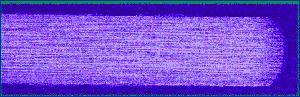
single
walled carbon nanotube. |
|
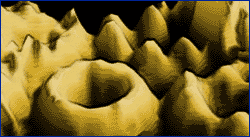
3-d
image of a molecule.
|
| 3)
Chemistry, physics, and mechanics of single molecules.
|
|
2)
Biomolecular nanomechanical systems.
The electronics industry has invested vast sums of money into research
in the area of silicon, microfabrication, and micromachining. However,
only a small percentage of this research work and fabrication methodology
finds itself into microelectronic products such as integrated circuits.
On the other hand, biotechnology and pharmaceutical industries, while
very advanced on the chemical side, is only beginning to realize possibilities
of miniaturization of sensing arrays, diagnostic methods, and even
more futuristically, smart drug delivery systems. My research is aimed
at using much of the untapped silicon micromachining and fabrication
technologies for bio-sensing and actuation applications using nanomechanics.
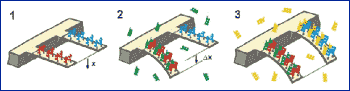
biorecognition. |
| This
research is aimed at exploring the inter-relationship of quantum mechanics,
chemical design and synthesis, and molecular mechanics at the level
of individual molecules. Research is highly interdisciplinary combining
the skills of synthetic chemists, theorists, and nanoscale scientists,
particularly in the area of imaging and spectroscopy. The research
is quite fundamental and has a clear long-range goal: programmed functionality
of a single molecule. Possible areas of future application include
quantum computing, molecular machines, and high-density peta-bit memories.
A theoretical goal also includes the operation of a machine that would
approach an energy-efficiency close to the limit set by the second
law of thermodynamics. |
|


